Brands can’t handle a “Staples Hottie”— So why do they want one so bad?
Employee-generated content, or EGC, is exactly what it sounds like: content created by employees rather than by a brand's official marketing team or outside creators. Think videos, posts, testimonials, and behind-the-scenes content made by the people who actually work there, used to represent the company publicly.
The industry has been celebrating this trend for a while now. Brands love the authenticity. Marketers love the efficiency. And the pitch is straightforward enough: employees already know the business's culture, customers, and language. They can communicate with a kind of credibility that polished brand copy cannot easily replicate.
I understand why that is compelling, because I’m on the other side of it.
Having been a full-time Creator for more than 6 years, it’s been a whirlwind lesson in self-advocacy. Almost everything I know about contracts, negotiation, red-lining agreements, and the real economics of brand partnerships, I had to learn on my own. There was no roadmap. No one sat me down and explained how much value I was actually providing or what I was entitled to ask for.
That learning curve cost me time, money, and more than a few deals I should have walked away from sooner.
So I share these thoughts this way because I do not think creators or employees should have to figure all of that out the hard way, and because the conversation around EGC is moving so fast that the people most affected are being left out entirely.
I understand why that is compelling. What I think the industry is underestimating (and what I think creators and employees are not yet fully equipped to navigate) is the structure underneath it.
EGC is being framed as a smart evolution in content strategy, but it is also quietly raising questions about labor, ownership, compensation, and public-facing risk that very few people are talking about clearly.
My view is not that EGC is inherently wrong. It is that the industry is adopting it faster than it has developed fair standards for how it should work, and that not every brand finds it in their best interest to prioritize these standards.
Whether you are a part-time creator with a 9-5, an employee, or someone who has ever been asked to show up on camera for your company without a real conversation about what that means, this piece is for you.
Remember when brand attitudes toward employee content were hostile? I do.
For a long time, brands were uncomfortable (or worse) with employees posting about work at all! A casual video from the office, a day-in-the-life clip, or a quick take filmed on the job could quickly become a policy issue.
In 2020, Business Insider reported on a worker who said she was fired after posting a viral menu-hack TikTok while working at Chick-fil-A. The message for years was consistent: employee visibility online was risky, and companies preferred to control it.
Now the pendulum has swung.
Brands have realized that audiences simply do not trust institutions the way they trust people.
The public is responsive to individuals, not polish. aka, People trust people, not logos.
That trust shift is one of the core reasons employee-generated content now looks so attractive to marketers. It gives brands relatability, internet-native storytelling, a lower-cost path to creator-style content, and people who already understand the product, the tone, and the values of the business.
But here is where the real tension lies: what brands call a content opportunity is, for the person creating it, often something more complicated.
Just like how you wouldn’t last one day as a stripper, “everyone can be a Creator!” is just not true. You don’t have the abs for it.
“Well, if this new company doesn’t work out I guess I’ll just start stripping.”
That’s the level of laissez-faire, unseriousness, and devaluation that people talk about becoming a Creator, by the way. Yes, I think strippers (who are athletes) get more respect than Creators. And it’s because people understand their job better.
The craft of being a social media content creator is undervalued because people still don’t understand it. The ability to represent a company publicly is a real skill. So is the ability to explain a product clearly, hold attention, build trust, and create content that feels native to a platform, instead of creative-briefed-to-death, is a true craft.
It is a muscle, like a six-pack. Built over time through painstaking contractions and tear—except the work outs are trends, scripts, flop-eras, and brutal internet commentary.
And that is not as casual as people like to make it seem.
When companies successfully identify an employee who is articulate, charismatic, funny, or unusually fluent in internet culture, that person can quickly become the face of company culture content, recruiting content, educational content, or brand thought leadership.
Sometimes that is framed as an opportunity. And sometimes it is.
But often, it is also scope creep. An employee hired for one function gradually becomes responsible for another: public-facing representation. And that second function is not a minor add-on.
It can involve scripting, filming, presenting, revising, and becoming personally associated with the company's reputation online. It can also expose the employee to criticism, screenshots, public commentary, and the strange permanence that comes with internet visibility.
Here is the pattern I see most often, and it is the one I want to name clearly: employees who are pulled into EGC situations tend to undervalue themselves. Not because they are not smart, but because they do not have the information they need to know what they are actually worth.
For example: they think that a small lump sum added to their salary, or a few extra dollars an hour, is a reasonable incentive. And they accept it, sometimes gratefully, without knowing what professional creators are actually paid for this kind of work. That’s if they think to have any expectation of pay at all. Many do not, especially if they’re already in a social media or content role.
And even if they work in a social media adjacent role, they do not truly know what the long-term labor of showing up consistently on camera actually looks like.
They do not know how much is being asked of them because no one has ever explained it plainly.
The Great Dr. Miami Crash-Out of 2026: Santina’s Revenge 2 years later
Thats exactly what happened to Santina Rizzi (@sanrizzle), the social media manager for viral TikTok sensation Dr. Miami who peaked on the platform between 2020-2024.
She's released at least six videos in the past week, exposing her experience as the social media manager for the viral plastic surgeon and the realities of being subject to work abuse, being underpaid, the scope, creep—and her own learnings, the long and hard way about using her face to build the platform and public reputation of an employer that exploited her
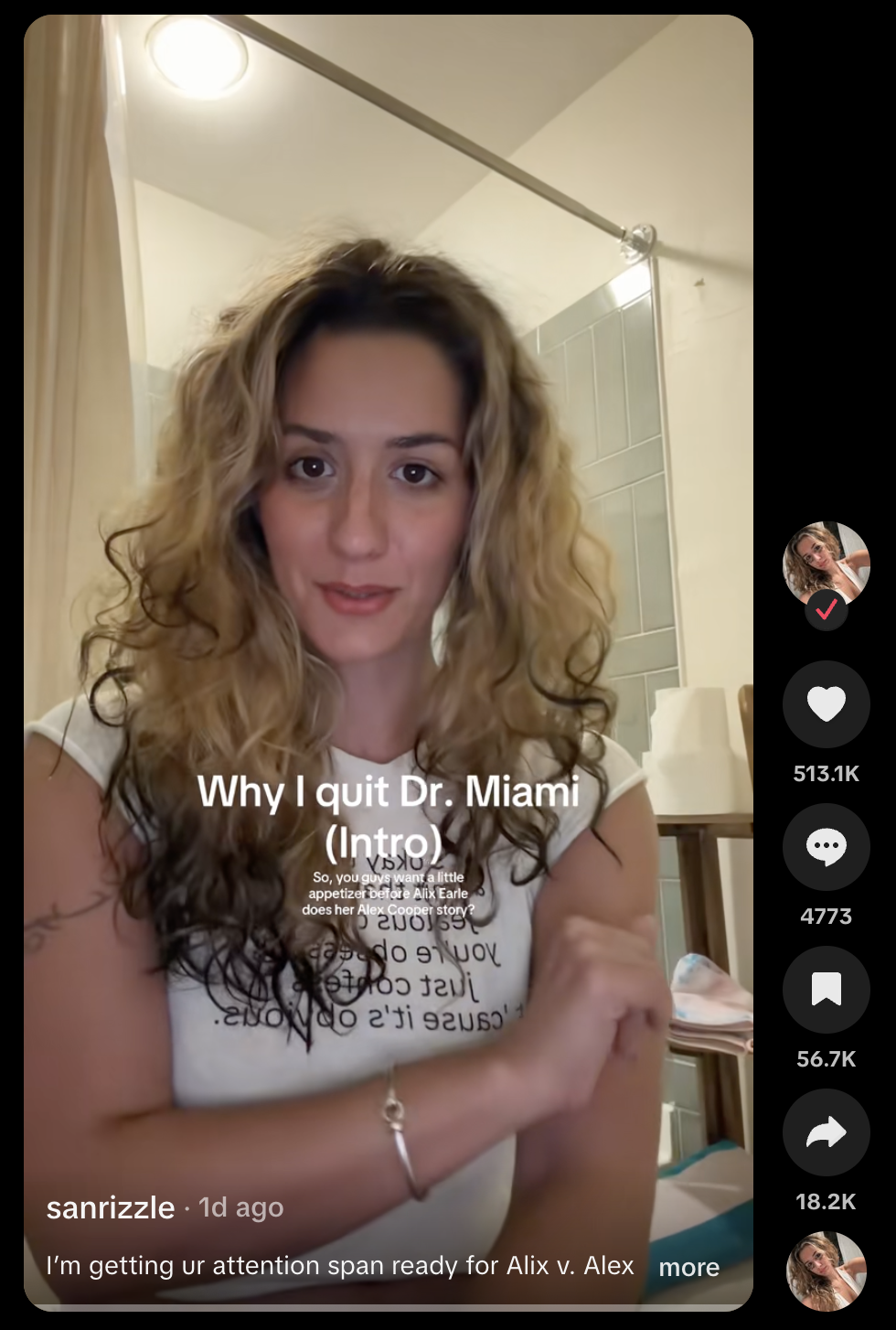
And yes. The internet is eating it up.
That lack of knowledge is doing a lot of work in the current EGC economy. It is making a genuinely expensive form of labor look cheap. And the people absorbing that cost are the ones on camera.
What I want creators and employees to understand is this: your likeness has value.
Your voice has value. The way you explain something has value. The trust people place in you has value. The fact that content feels more believable when it comes from you rather than a brand account has value.
And brands, I want you to understand this: if you think too short-term about EGC, you will be on the receiving end of similar public crash-outs from current or past EGC creators. And I don’t think it’s worth it.
We need to break down“Work-for-Hire”
There is one issue the industry talks about the least, and it is the one with the most long-term consequences: ownership.
As a creator, one of the first things I look for in a contract is whether the work is being treated as work made for hire. Because that changes the value of the deal immediately. If I retain ownership and a brand is licensing the content, that is one arrangement. If ownership transfers entirely, that is another.
The U.S. Copyright Office is clear on the basic principle: when a work is made for hire, the employer or commissioning party is considered the author and owns the copyright from the outset.
That may sound like a dry legal distinction, but in practice, it is everything. It determines who controls the asset, who benefits from its long-term value, and what the creator or employee is left with after the work has done its job.
Many employees being asked to make content for their company are effectively entering a work-for-hire dynamic without ever being taught to think about it that way. The company often owns the asset. The employee may be the face of it, the voice of it, the reason it performs and the reason audiences trust it, while retaining little to no ownership over what they helped make valuable. The company keeps the archive. The company keeps the clips. The company keeps what I would call the media equity.
3 Things Employees Should Do Before Saying Yes
If you are being asked or contracted to create content for your employer on a regular basis, here are the concrete steps I would encourage you to take before agreeing to anything:
Ask who owns the content. Is it solely your face? Is it the entire office? Is this work-for-hire, where the company owns everything from the moment you create it? Or are you licensing your likeness and your content for a specific period and purpose? Can you make related videos on similar topics and own them, or not? Can you make your own spin-off series and own it, or not? Get clear on these terms and think about the value and long term limitations of whatever the terms are, before you say yes.
Push for a separate work contract and consider having your own lawyer review it. Whatever your existing employment agreement says, EGC should be governed by a completely separate contract. This contract should address: who owns the content, what the payment structure looks like, what happens if the company ends the arrangement early, what happens if you leave the company, what protections exist if you face public backlash, and whether the company is obligated to defend you publicly if needed. The company's legal team works for the company. If there is meaningful money or public exposure involved, it is worth having your own counsel look at what you are signing.
Make sure you can protect yourself if things go wrong. This one is critical and it is the thing people think about least. Right now, you may feel great about your employer. But the internet does not care about your current relationship with your company. Ask yourself: if this brand faced a public scandal, could you separate yourself from the content you made for them? If you are receiving hateful or harmful comments as a result of your public-facing role, is the company obligated to moderate, remove, or publicly address them? If you go through a rough patch at work and they decide to part ways with you mid-campaign, what are your protections?
Think about what it would have meant to be the public-facing employee creator for Target in 2025. After the brand rolled back its DEI initiatives, PBS NewsHour reported that the resulting consumer boycott contributed to stalled sales, a plunging stock price, and ultimately the departure of CEO Brian Cornell
If you had built your online identity around representing that brand and that story broke, you would want to know exactly what your contract said about distancing yourself. You would want to know if the company was obligated to have your back. You would want options.
That is not a hypothetical. That is the internet. It is worth thinking through before it becomes your reality.
What Good EGC Actually Looks Like: The Staples Baddie
I want to be clear that there is a fair and genuinely exciting version of employee-generated content! And we have a real example of what it can look like when it works.
Kaeden, known online as @blivxx or the "Staples Baddie," is a Staples employee who started posting organically on TikTok in early 2025, creating ASMR-style tutorials and informational videos exploring her workplace and highlighting niche products and services the store offers. The content is distinctly Gen Z: heavy slang, dry humor—aka, completely authentic to who she is.
Comments flooded in. Viewers started going to Staples because of what they saw on her page. For a brand that has been navigating the pressures of an increasingly online-shopping-driven economy, this was meaningful.
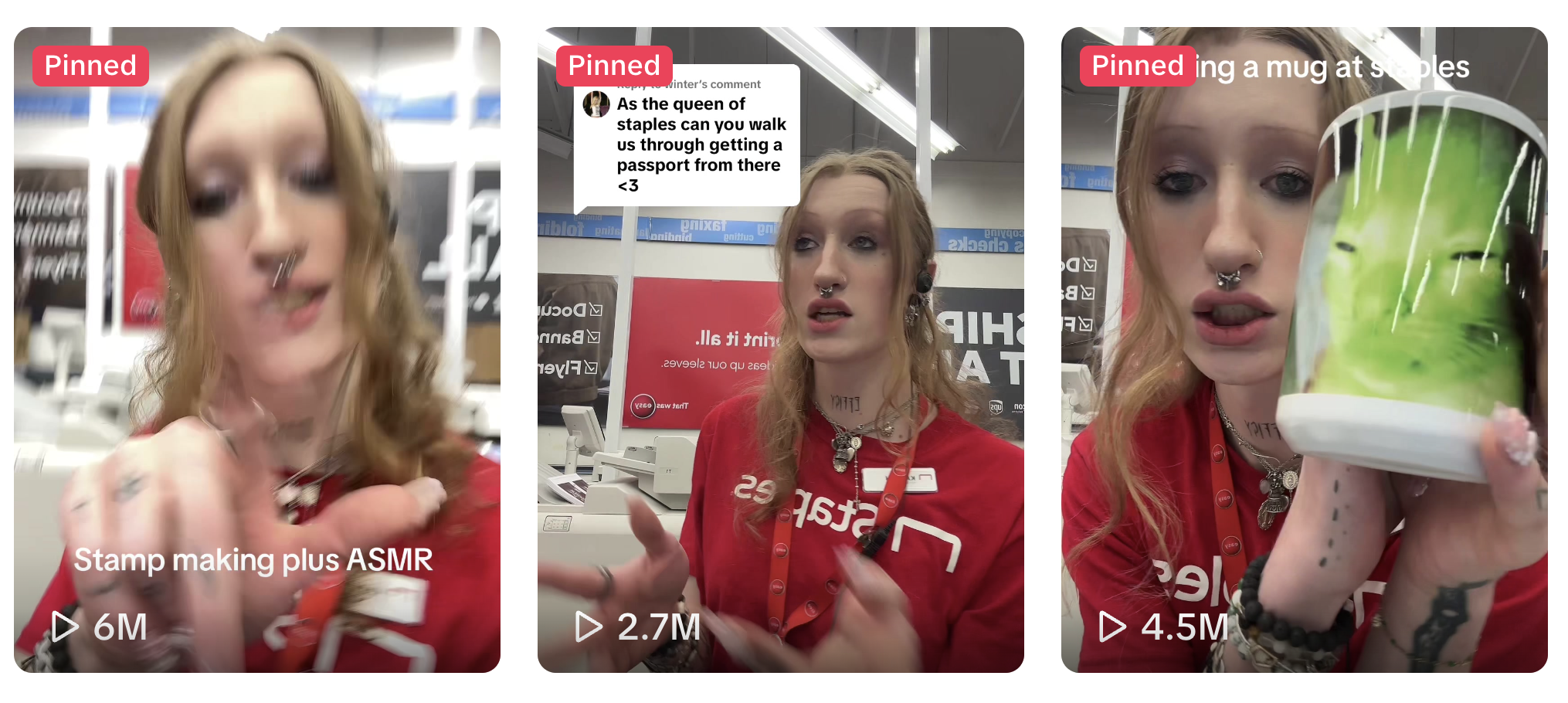
The Staples Baddie herself.
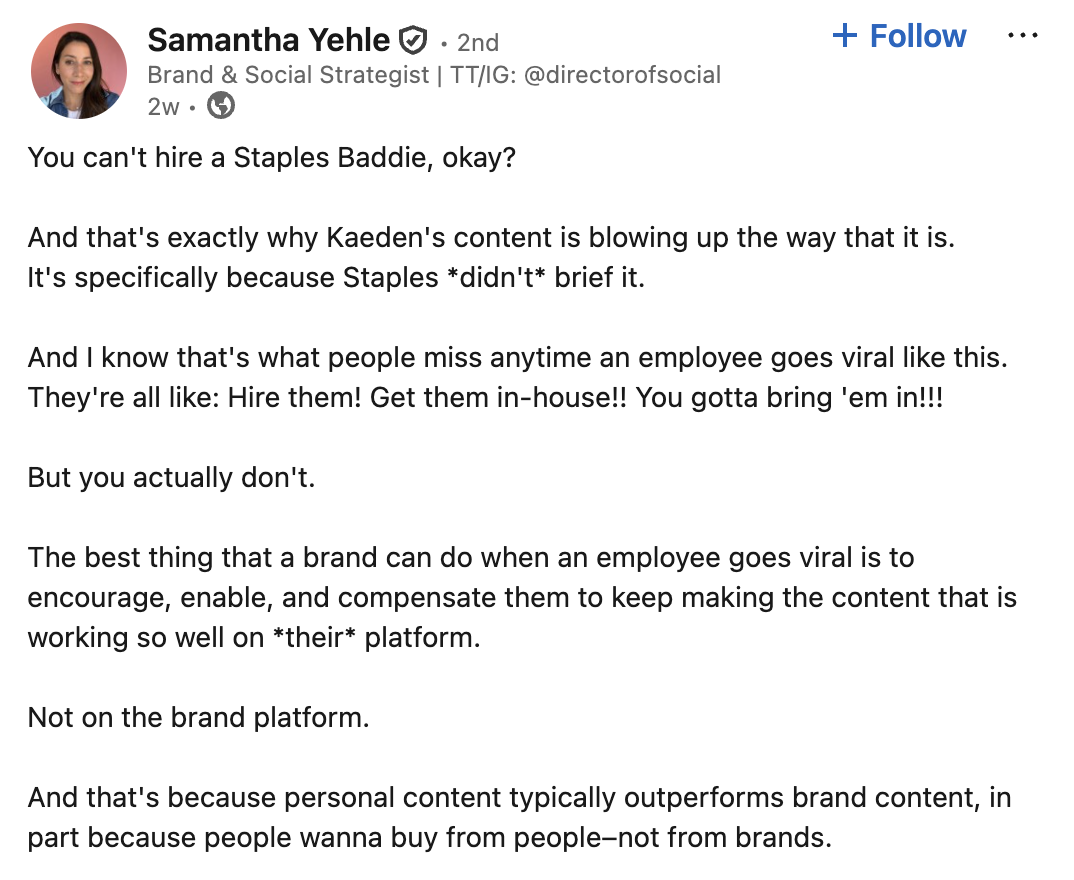
Apt LinkedIn commentary on the Staples Baddie from another Brand and Social Strategist.
What makes the Staples Baddie a good example is not just that it’s blowing up on social media. It is how Staples responded.
Rather than sending a cease-and-desist or discouraging it behind the scenes, Staples has built an environment of safety, support, and structure for the employee.
Their CMO Bob Sherwin told Fast Company the company was "incredibly proud" of Kaeden and was "exploring opportunities to collaborate and continue supporting her creativity." The plan was for her to keep making content her way, with the company's support but without scripts, logo overlays, or corporate sanitizing.
A marketing miracle. Angels are truly singing.
What makes this great EGC:
Kaeden is keeping their full personality.
The brand is not feeding them lines.
The company is explicitly treating this as mutually beneficial (which it is!) which means, at minimum, that someone is having a real conversation about what that mutual benefit looks like in practice.
Brands, ask yourselves: are you ready to do that? Is your legal team ready to do that? Do you have C-suite buy-in to do that?
The EGC success model: organic origin. Authentic voice. Explicit company support. Genuine acknowledgment that what employees do has strategic value and that they deserve to be treated accordingly.
We do not know the full details of Kaeden's arrangement, but the public posture from Staples reflects something important: a company that recognizes this is not just free content. It is a creator relationship.
Because creator relationships, when done with respect, look like real partnerships!
A Practical 2026 Brand Guide to EGC:
If you are a brand or agency reading this, here is what I think a responsible EGC program actually requires:
A separate contract that is entirely distinct from the employee's original employment agreement, regardless of their role. Whether they are in HR, engineering, or social media, the EGC work is a different scope and it needs to be treated that way.
Clear language on ownership, usage rights, payment schedule, and what happens at the end of the arrangement, including early termination scenarios for both parties.
Real public-facing protections. If an employee is serving as a spokesperson for your brand, you owe them a commitment to moderate hateful comments, address harmful rhetoric directed at them, and defend them publicly when necessary.
Genuine opt-in participation. Not soft pressure. Not framing it as an opportunity without explaining the full picture. Actual informed consent from someone who understands what they are agreeing to.
Compensation that reflects creator-level value, not a slight bump to an existing salary. If the content is doing creator work, it should be compensated accordingly.
The brands and agencies that build these standards now will be ahead of where the industry is inevitably heading. The people being asked to create this content are getting more informed. The questions they are going to start asking are already forming.
And the brands that have thought through those questions before they become demands will be the ones positioned to do this well.
Let’s keep the E for “Employee” and not “Exploitation”, please!
EGC is celebrated as a smart response to a more human internet. Kaeden at Staples is a genuinely great example of what this can look like when a company respects its employees' voices and treats the arrangement as a real partnership.
And there is a world where brands present the opportunity to employees to create content of their own volition like Kaeden—with briefs, reiteration of guidelines, and no formal partnership.
Just optionality, whether the employee-creators retain ownership and creative freedom, and it just happens to benefit their company.
I have also worked with brands that got this right, that moved intentionally, that treated the creator relationship as a real partnership rather than a line item. That experience is just as much a part of why I am sharing these thoughts!
If this piece gives one brand team something concrete to bring to their leadership, or slows one conversation down long enough to ask the right questions with intention, that matters to me and is a step in the right direction for the entire industry.
(Brand-enabled—but not brand contracted) EGC? Peak free will. Go crazy.
But the current model too often allows companies to access creator-style authenticity, insider credibility, and internet-native communication without adopting creator-style compensation structures, ownership conversations, or public-facing protections. That gap is where the labor problem lives.
Efficiency built on underpriced labor tends not to hold forever. Eventually, the people doing the labor become more literate. And they start asking better questions:
Is this actually part of my role? How is this work being valued? Who owns this content? What protections exist if I face public backlash? What, exactly, am I building, and who gets to keep it?
Those questions are already forming.
If you are a creator or an employee, I want you to know that you are not wrong for asking them. You are not being difficult. You are being appropriately informed about the value of what you are offering and what a fair arrangement should look like.
Creators of any kind: Your likeness, your voice, your trust, your presence. Those things have always been worth more than the industry initially wants to admit. The sooner you know that clearly, the better positioned you are to negotiate accordingly.
Long story short, let’s keep the E in EGC for “Employee” and not “Exploitation”, please!
***
Gabby Beckford is an Engineer → Influencer with an audience of 800K+, and Influencer Marketing Expert. After 6 years full-time, she fluently translates insights between brands, agencies, creators, and audiences in a practical and relatable way and with uniquely-her #CreatorPOV. Work with Gabby.